01
Guided first run
Create or join from one launcher. The saved role starts automatically on later launches.
Distributed LLM Universal connects compatible Windows and Linux machines into one llama.cpp inference cluster. Run the source directly or use the admin-free portable worker, approve machines, and launch a GGUF model from the dashboard.
$ python run.py

Choose:
  1. Create a cluster
  2. Join a cluster

Coordinator dashboard:
  http://YOUR-IP:7000
The management app stays lightweight. Model execution is delegated to official, hardware-optimized llama.cpp binaries, while portable workers use an authenticated outbound TLS tunnel.
Create or join from one launcher. The saved role starts automatically on later launches.
Detects operating system, architecture, CPU features, RAM, GPUs, and network address.
Finds coordinators automatically, then protects enrollment with a join code and approval.
Downloads a suitable CPU, Vulkan, CUDA, or ROCm backend and runs quantized GGUF models.
Benchmarks workers and creates a RAM- and performance-weighted tensor split.
Extract and run without Python, sudo, services, inbound worker ports, or an installer.
Run python run.py and choose Create a cluster.
Run the normal app or extract the portable worker, enter the coordinator address and six-digit code, then approve it.
Approve workers, install the backend, choose a GGUF model, then select Download & run.
| Model | Quantization | Approx. weights | Use |
|---|---|---|---|
| Qwen3 0.6B | Q8 | 0.64 GB | Backend test |
| Qwen3 1.7B | Q8 | 1.83 GB | Very weak devices |
| Qwen3 4B | Q4_K_M | 2.50 GB | Low-power default |
| Qwen3 8B | Q4_K_M | 5.03 GB | Medium cluster |
| Qwen3 14B | Q4_K_M | 9.00 GB | Larger mixed cluster |
The dashboard adds runtime, context, and operating-system headroom before marking a model as suitable. More machines mainly add usable memory and throughput; they do not multiply the speed of one response.
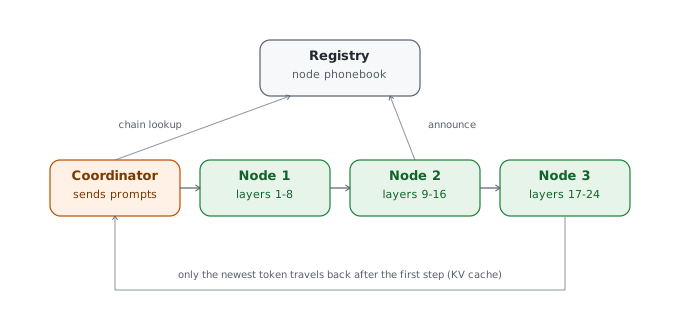
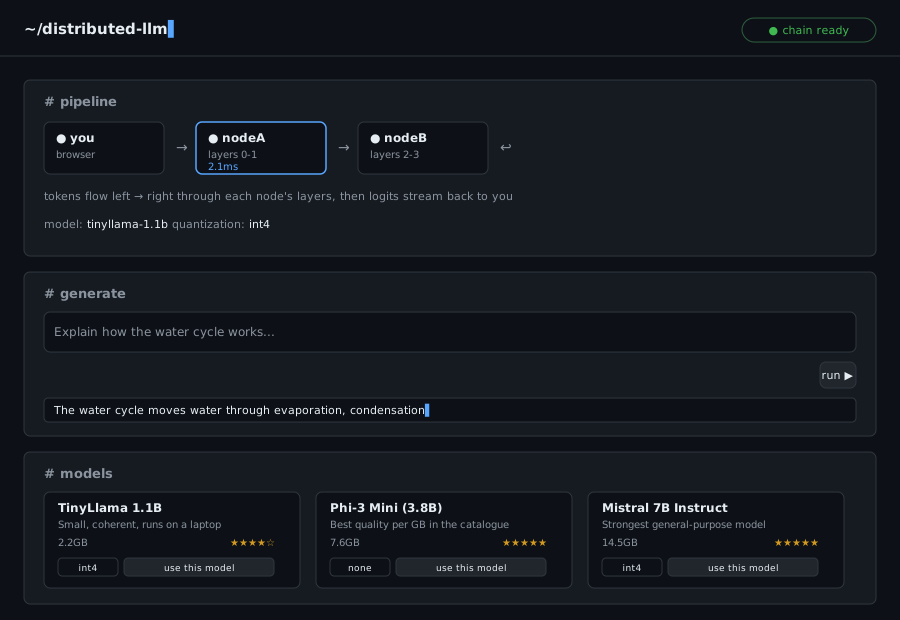
The restored prototype site, architecture drawing, dashboard preview, and whitepaper document the original custom-transformer design. The current Universal release instead uses llama.cpp RPC for the model runtime; those older materials are preserved as project history, not as current setup instructions.